

How it works
Six stages, in order. Each one earns the next.
The interview builds the evidence. The evidence drives the search. The search feeds the fit-scoring. Only then does anything get written, and only by you does anything get sent. Nothing is skipped and nothing is faked. Here is the whole chain.
Stage one
The coach interview
Most tools read your CV and work from what is already on it. We start from the opposite assumption: your CV left things out. The coach interviews you the way a good career coach would. It asks what you actually did, who was struggling before you fixed it, and what changed after. When you reach for a vague word, it pushes back.
You will not always have the exact number to hand. That is normal. The coach estimates it with you from first principles, the way a consultant sizes a market on a whiteboard. This is Fermi quantification: a defensible estimate you can stand behind, built out loud so you understand every figure in it.
Inside the interview
You wrote "improved onboarding." Who was struggling before you changed anything, and how did you know?
New starters took about six weeks to pull their weight. We never measured it. It was just obvious.
Good. That is the situation. Now the size of it. How many people started that year? What does a day of their time cost the business, roughly? And how much faster were they once you had finished?
Stage two
The Evidence Bank
Everything the coach draws out is stored as a structured story, in the STAR-L shape: Situation, Task, Action, Result, Learning. Each story is tagged to the competencies it proves. One good story answers a dozen different job requirements, so you write it once and reuse it for the rest of your search. The bank is the asset. It compounds.
One story in the bank
Cutting onboarding time at a logistics firm
- Situation
- At a 40-person logistics firm, new operations hires took roughly six weeks to reach full productivity. Nobody had measured it.
- Task
- I owned onboarding. The brief was informal: get new people useful sooner.
- Action
- I built a two-week structured plan, paired every starter with a named buddy, and moved scattered training notes into one place people could actually find.
- Result
- New starters were productive in about four weeks instead of six. No one had logged a formal figure, so the coach and I estimated it from first principles.12 hires × 10 working days saved × £180/day ≈ £22,000 recovered in year one
- Learning
- The buddy pairing did more than the documents. If I ran it again I would start there.
That figure is an estimate and it says so. The coach never inflates it. A defensible £22,000 you can talk through in an interview beats an invented £100,000 you have to dodge questions about.
Stage three
Discovery
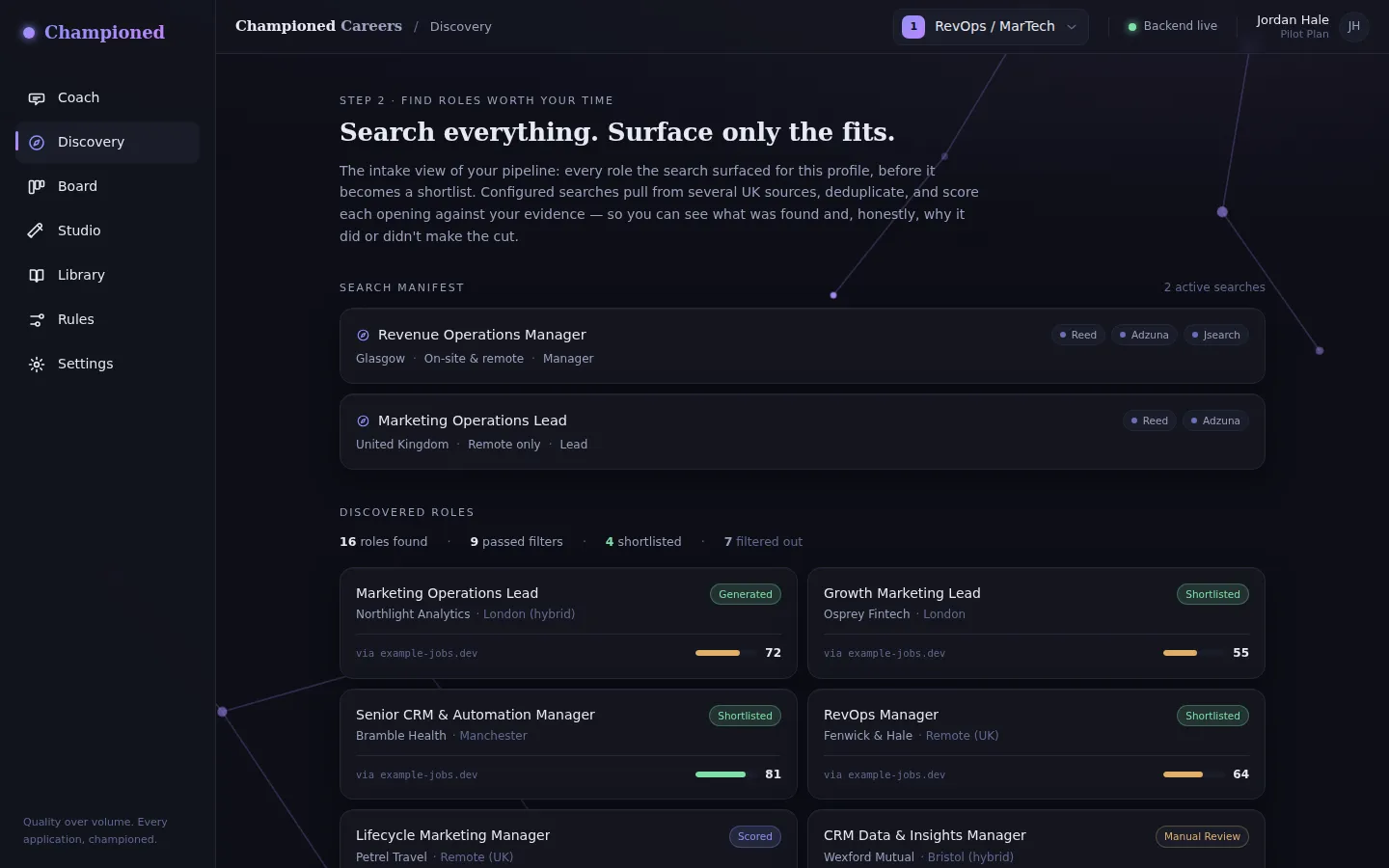
Now the search knows what you are made of. Discovery looks for roles your bank can actually win, not just roles that match the title you typed. It pulls from more than one UK source, Reed and Adzuna and an aggregator among them, then removes the duplicates so each role reaches you once rather than four times.
The point is a shortlist you trust, not a firehose. A shorter list of roles worth your evening is more useful than a thousand you will never read.
Stage four
The Reality Check
Before a single word is written, each role is scored against your evidence. The rule is simple: for every requirement the job states, can we point to a real story in your bank? If we can, it counts. If we cannot, it is a gap, and the verdict names it plainly. We would rather you applied to three roles you can win than thirty you cannot.
Reality Check
Head of Operations, mid-size SaaS
Verdict: worth applying. Lead with the supply-chain turnaround.
- Team leadership. Three stories in your bank.
- Process redesign. The onboarding and returns-handling stories both cover it.
- Budget ownership. To £1.2m.
- P&L over £5m. You have run budgets, not a full P&L at that scale. A real gap, not a wording one. Do not pretend otherwise.
- SaaS sector experience. None yet. Framable as adjacent, one sentence, no more.
Two of nine requirements are genuine gaps. Neither is a hard blocker for this employer. Apply, name the P&L gap honestly, and let the operations record carry it.
Some roles get a blunter verdict: do not spend your evening on this one. When a role asks for a qualified actuary and you are not one, no framing fixes that. We say so, and point you back at the roles where you have a real shot. A tool paid by the application cannot afford to tell you that. We can.
Stage five
The Studio
This is where the writing happens, and it is not one pass through a chatbot. A drafter writes from your bank. An auditor then reads it back as a sceptical senior hiring manager would, in the first ten seconds, and marks anything that smells of AI, hype or begging. The draft gets filed down until it reads like a person wrote it, because a person is who it has to convince.
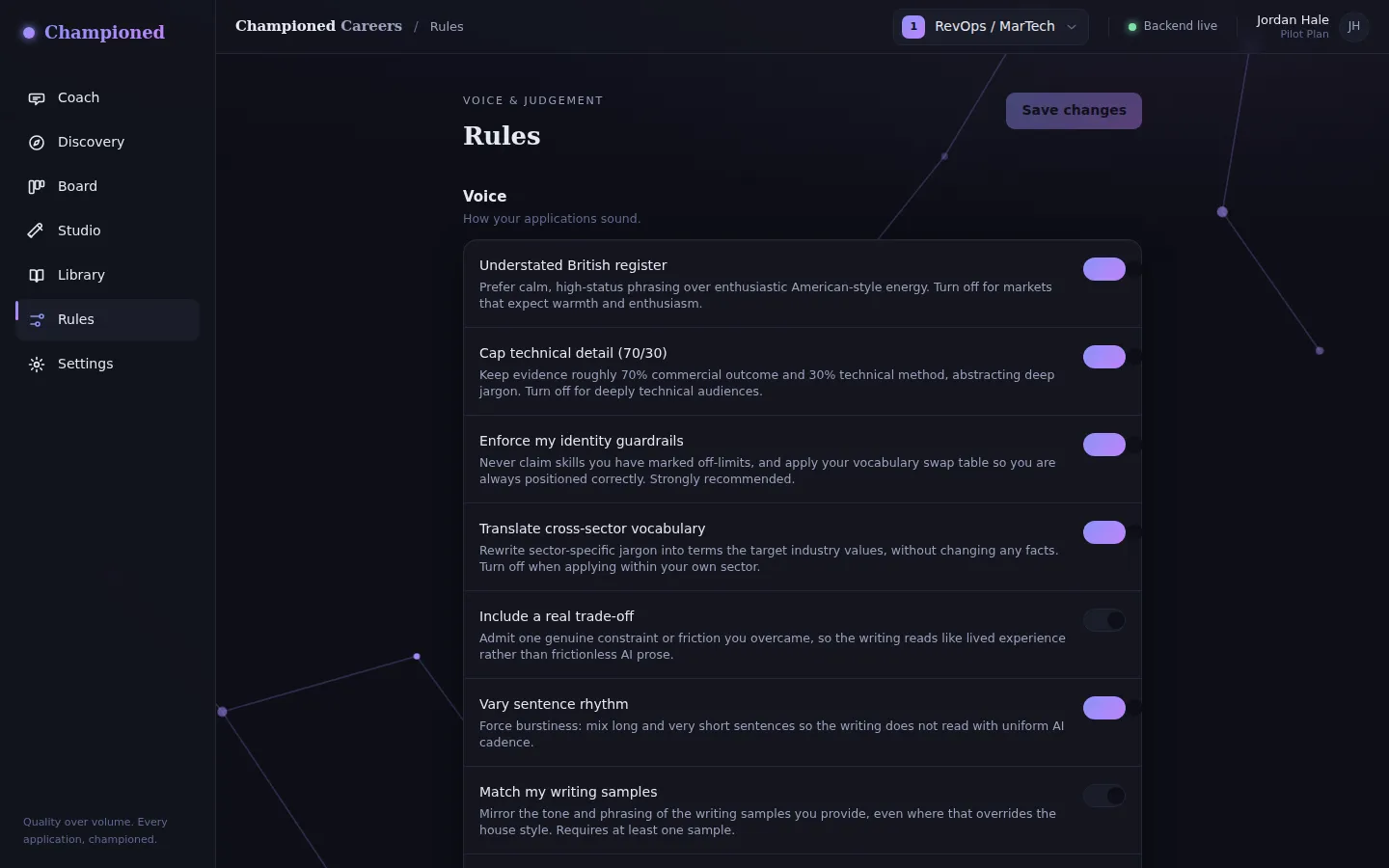
The whole process runs against voice and humaniser rulebooks tuned on real senior applications, and it borrows the cadence of your own approved writing samples so it sounds like you. No stock "I am thrilled to apply." No "leverage," no "seamless," none of the words that mark an application as machine-written and get it binned.
Stage six
You press submit
The last step is always yours. The Studio hands you a finished draft. You read it, change what you want to change, and submit it yourself on the employer's own site. There is no bot filling in forms while you sleep. You press submit, on every application, every time.
That is a principle, and it is also how we stay on the right side of every platform's terms. The two happen to be the same thing.
Mission control
The whole chain, in one sky.
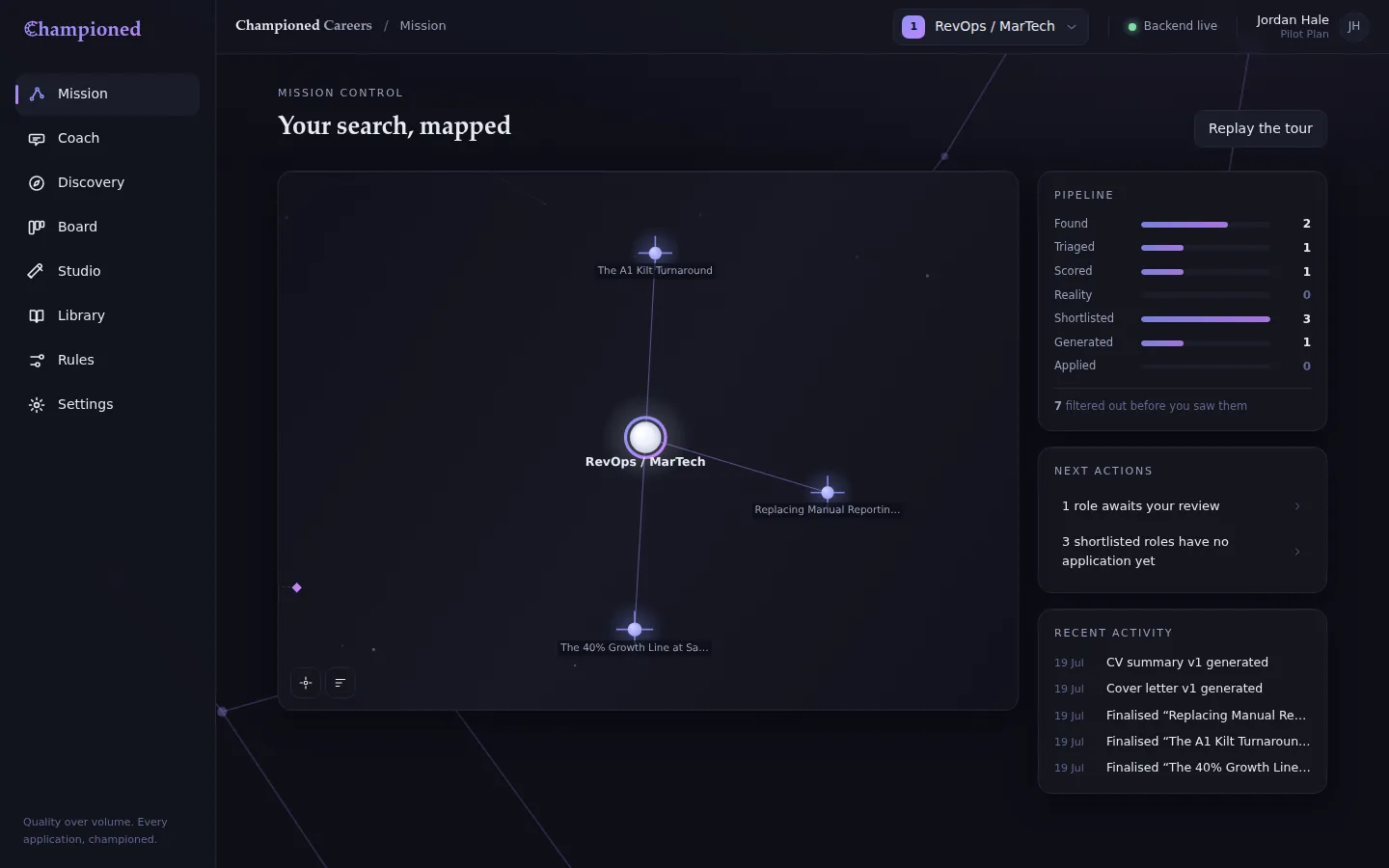
The six stages do not sit in six separate screens. The Mission Dashboard draws your whole search as a single map: your banked stories at the centre, the roles Discovery found orbiting them, and the applications the Studio drafted in flight between. Each star opens the pane that owns it, so the overview and the detail are never more than a click apart.
It begins nearly empty, because it only ever shows what is real. Every story you bank lights another star. A guided first-look maps an example search before you begin, so the whole idea is clear from the start.
What we won't do
A few things we decided not to build, on purpose.
No auto-spam
We will not fire your CV at fifty roles a day. That is the behaviour employers are actively defending against, and it does not work. Jobscan puts callback rates for fully automated apply tools at 1 to 6 per cent.
No fabrication
We frame your evidence, we never invent it. If your bank cannot point to a real story behind a claim, the claim does not go in. An estimate is labelled as an estimate. Framing is fair. Invention falls apart in the interview.
No bot submissions
Indeed's terms of service explicitly prohibit using automation, scripting or bots to automate the Indeed Apply process. We respect that, and we would anyway. You submit your own applications, on each platform's own terms.
None of this is a limitation we are apologising for. It is the product. The compliance is the respect.
See it on your own applications.
Pilots open soon. Join the waitlist and you will be among the first to put your evidence through the chain.